Bitcoin Remains at Risk, Why 100 SMA Is The Key
[ad_1]
Bitcoin is still struggling below $41,500 against the US Dollar. BTC remains at a risk of more downsides below the $39,000 support zone.
Bitcoin is showing bearish signs below the $40,500 and $41,500.
The price is now trading below $40,500 and the 100 hourly simple moving average.
There is a key bearish trend line forming with resistance near $40,180 on the hourly chart of the BTC/USD pair (data feed from Kraken).
The pair could extend decline if there is a clear move below the $39,000 support zone.
Bitcoin Price Resumes Decline
Bitcoin price remained below the key $41,500 resistance zone. BTC seems to be trading in a range above the $39,000 level and below the $41,500 resistance zone.
The last swing low was formed near $39,600 before the price started an upside correction. There was a move above the $40,000 resistance zone. The price climbed above the 23.6% Fib retracement level of the downward move from the $41,548 swing high to $39,600 low.
However, the price faced a strong resistance near the $40,500 level and the 100 hourly simple moving average. Bitcoin also struggled near the 50% Fib retracement level of the downward move from the $41,548 swing high to $39,600 low.
There is also a key bearish trend line forming with resistance near $40,180 on the hourly chart of the BTC/USD pair. An immediate resistance on the upside is near the $40,200 level.
The next key resistance could be $40,380 and the 100 hourly SMA. To start a recovery wave, the price must clear the $40,380 zone and the 100 hourly SMA. In the stated case, the price may perhaps rise towards the $40,850 resistance zone. Any more gains could set the pace for a move towards the main $41,500 hurdle in the near term.
More Losses in BTC?
If bitcoin fails to clear the $40,180 resistance zone, it could start another decline. An immediate support on the downside is near the $39,600 level.
The next major support is seen near the $39,180 level. A downside break below the $39,180 support zone could accelerate losses. In the stated case, the price could decline towards the $38,800 level or even $38,500.
Technical indicators:
Hourly MACD – The MACD is now losing pace in the bearish zone.
Hourly RSI (Relative Strength Index) – The RSI for BTC/USD is now below the 50 level.
Major Support Levels – $39,600, followed by $39,180.
Major Resistance Levels – $40,180, $40,400 and $41,500.
Grayscale Investments’ CEO explains that the U.S. Securities and Exchange Commission (SEC) could potentially violate the Administrative Procedure Act by not approving a spot bitcoin exchange-traded fund (ETF).
SEC Approving Spot Bitcoin ETF Is ‘a Matter of When and Not If’
The U.S. Securities and Exchange Commission (SEC) has now approved not one but two different structures of bitcoin futures exchange-traded funds (ETFs). This has led to the optimism in the crypto industry that the securities watchdog is closer to approving a spot bitcoin ETF.
The first structure utilizes the Investment Company Act of 1940 (40 Act). Most proposed bitcoin futures ETF to date are filed under this Act. The second uses the Securities Act of 1933 (33 Act). The Teucrium Bitcoin Futures ETF was approved earlier this month using the latter structure.
Grayscale Investments CEO Michael Sonnenshein explained to CNBC last week: “From the SEC standpoint, there were several protections that 40 Act products have that 33 [Securities Act of 1933] products don’t have, but never ever did those protections address the SEC’s concern over the underlying bitcoin market and the potential for fraud or manipulation.”
He continued: “So the fact that they’ve now evolved their thinking and approved a 33 Act product with Teucrium really invalidates that argument and talks to the linkage between the bitcoin futures and the underlying bitcoin spot markets that give the futures contracts their value.” Sonnenshein opined:
If the SEC can’t look at two like issues, the futures ETF and the spot ETF, through the same lens, then it is, in fact, potentially grounds for an Administrative Procedure Act violation.
The Administrative Procedure Act (APA) governs the process by which federal agencies develop and issue regulations.
Grayscale filed with the SEC on Oct. 19 last year to convert its flagship bitcoin trust (GBTC) into a bitcoin ETF. GBTC is Grayscale’s largest product with almost $26 billion in assets under management as of April 15. If approved by the SEC, GBTC will be listed on the New York Stock Exchange, instead of on OTCQX.
The company is waiting to hear back from the SEC in early July about whether the filing will be approved. The CEO has hinted that suing the SEC is a possible option the company will take if the agency does not approve the GBTC conversion.
Commenting on whether the SEC will approve a spot bitcoin ETF, Sonnenshein stressed:
It really is, in our opinion, a matter of when and not if.
Do you think the SEC will soon approve a spot bitcoin ETF? Let us know in the comments section below.
Kevin Helms
A student of Austrian Economics, Kevin found Bitcoin in 2011 and has been an evangelist ever since. His interests lie in Bitcoin security, open-source systems, network effects and the intersection between economics and cryptography.
Image Credits: Shutterstock, Pixabay, Wiki Commons
Disclaimer: This article is for informational purposes only. It is not a direct offer or solicitation of an offer to buy or sell, or a recommendation or endorsement of any products, services, or companies. Bitcoin.com does not provide investment, tax, legal, or accounting advice. Neither the company nor the author is responsible, directly or indirectly, for any damage or loss caused or alleged to be caused by or in connection with the use of or reliance on any content, goods or services mentioned in this article.
Fidelity Investments Launches Crypto, Metaverse ETFs — Says ‘We Continue to See Demand’ – Finance Bitcoin News
[ad_1]
Fidelity Investments, one of the largest financial services firms with more than $11 trillion under administration, is launching exchange-traded funds (ETFs) focusing on the crypto ecosystem and the metaverse. “We continue to see demand, particularly from young investors, for access to the rapidly growing industries,” said Fidelity.
Fidelity Sees Demand for Crypto, Metaverse Investments
Fidelity Investments announced the launch of a couple of exchange-traded funds (ETFs) this week to offer investors exposure to the crypto industry and the metaverse.
The first is called “Fidelity Crypto Industry and Digital Payments ETF (FDIG).” It invests in companies that “support the broader digital assets ecosystem, including those involved in crypto mining and trading, blockchain technology, and digital payments processing,” the firm described. However, this crypto ETF will not offer direct exposure to cryptocurrency.
The second is called “Fidelity Metaverse ETF (FMET).” It invests in companies that “develop, manufacture, distribute, or sell products or services related to establishing and enabling the metaverse.” They include firms focusing on “computing hardware and components, digital infrastructure, design and engineering software, gaming technology and software, web development and content services, and smartphone and wearable technology.”
The new ETFs will be available on or about April 21 for individual investors and financial advisors to purchase commission-free through Fidelity’s online brokerage platforms, the announcement details. The company noted that with the new products added, Fidelity will offer 51 ETFs altogether.
Fidelity is a major financial services firm with assets under administration of $11.1 trillion as of February. Headquartered in Boston, the company serves more than 40 million individual investors worldwide.
Greg Friedman, Fidelity’s head of ETF management and strategy, commented:
We continue to see demand, particularly from young investors, for access to the rapidly growing industries in the digital ecosystem, and these two thematic ETFs offer investors exposure in a familiar investment vehicle.
What do you think about Fidelity launching crypto and metaverse ETFs? Let us know in the comments section below.
Kevin Helms
A student of Austrian Economics, Kevin found Bitcoin in 2011 and has been an evangelist ever since. His interests lie in Bitcoin security, open-source systems, network effects and the intersection between economics and cryptography.
Image Credits: Shutterstock, Pixabay, Wiki Commons
Disclaimer: This article is for informational purposes only. It is not a direct offer or solicitation of an offer to buy or sell, or a recommendation or endorsement of any products, services, or companies. Bitcoin.com does not provide investment, tax, legal, or accounting advice. Neither the company nor the author is responsible, directly or indirectly, for any damage or loss caused or alleged to be caused by or in connection with the use of or reliance on any content, goods or services mentioned in this article.
Another DeFi platform took a major hit today, as the decentralized, credit-based stablecoin Beanstalk (with it’s stablecoin $BEAN) has broken it’s peg following a roughly $80M hack.
Speculation has been left, right and center and a number of sleuths have been tracking the movement of funds and studying the exploit that has likely left Beanstalk Farms in the dust.
Let’s look at what we know from the early hours since the hack.
Beanstalk Farms’ Hack: What Went Down
The transaction on Etherscan shows that the hacker used what’s commonly known as a ‘flash loan attack,’ one that has been seen on DeFi protocols previously. A flash loan in crypto allows a user to borrow and repay a loan in a single transaction, which minimizes risk for lenders and can streamline processes for borrowers.
In the Beanstalk Farms hack, the hacker borrowed nearly a third of the BEAN supply, roughly 32 million tokens and utilized Curve Finance’s $3Crv tokens to generate a unique tokens ‘BEAN3CRV-f’ and ‘BEAN3LUSD-f.’
The attacker utilized these two new tokens to deceive Beanstalk’s governance model and gave the hacker a massive majority holding of ‘seeds,’ the platform’s governance token. With such a larger holding of seeds, the hacker had the contractual capability to execute an ’emergency governance action,’ siphoning massive amounts of funds from the Beanstalk contract.
The hacker even included a $250K donation to the Ukrainian donation address as part of the hack, and set up the governance proposals over 24 hours prior to actual execution of the flash loan attack.
Lossless (LSS) has reached out to Beanstalk; the project is an increasingly-utilized tool to combat against potential hacks. | Source: LSS-USDT on TradingView.com
Related Reading | Bitcoin Clings To $40K On Easter Sunday As Crypto Seen To Head Lower In The Short Term
Can The Protocol Recover?
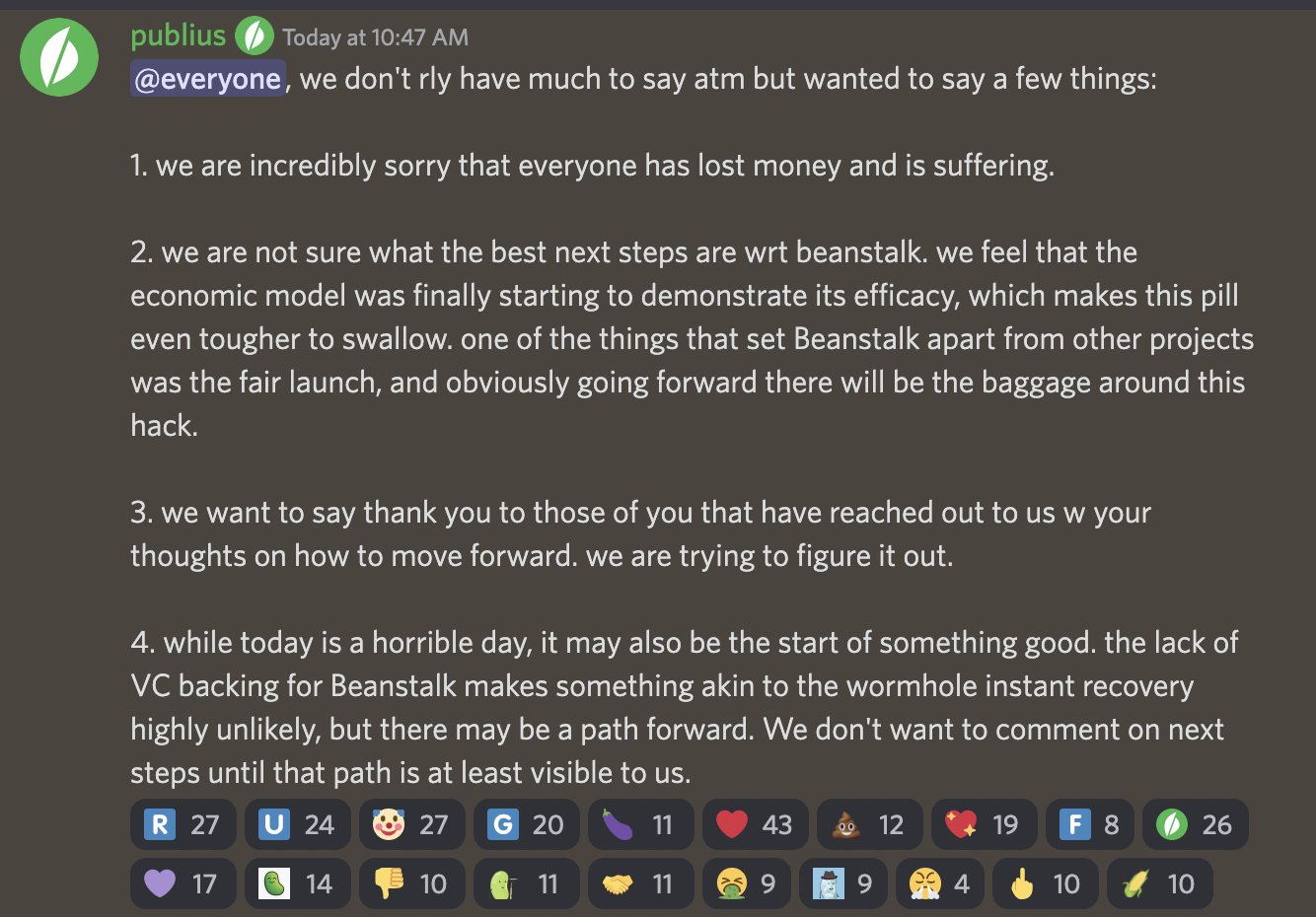
Just days ago, Beanstalk was celebrating over $150M in TVL, over $130M in liquidity, and a rapidly approaching market cap of $100M that was impending. The protocol has had to pump the brakes, and it’s future is now unclear – with a stark Discord screenshot from admins:
How the protocol recovers from here will be difficult to predict. Additional Discord screenshots show that the project is not shutting down immediately, but is also not committing towards an eventual re-build:
Crypto hack mitigators Lossless have reached out and Beanstalk will likely need strong partners to recover from this. Commentors on Beanstalk’s Twitter account have speculated that it was an ‘inside job’ conducted by Beanstalk to leave retail as exit liquidity. However, until more details come to light, it’s all speculation.
We’re engaging all efforts to try to move forward. As a decentralized project, we are asking the DeFi community and experts in chain analytics to help us limit the exploiter’s ability to withdraw funds via CEXes. If the exploiter is open to a discussion, we are as well.
Related Reading | ADA To Rebound With Integration Of USDT And USDC On Cardano
Featured image from Pixabay, Charts from TradingView.com
The writer of this content is not associated or affiliated with any of the parties mentioned in this article. This is not financial advice.
NFT Sales Volume Saw a Small Uptick This Week — Moonbirds, Mutant Apes Take Top Sales – Markets and Prices Bitcoin News
[ad_1]
Non-fungible token (NFT) sales saw a small uptick over the last week as $658.4 million in NFT sales were recorded, up 3.35% in seven days. Out of 15 blockchains, Polygon-based NFT sales saw the largest increase in volume, jumping 106.68% this week. Moreover, over the last seven days, an NFT collection called Moonbirds saw the largest sales volume gathering $231.9 million.
Weekly NFT Sales Record a Slight Increase
NFT sales volume managed to increase slightly this week, as sales jumped 3.35% higher than last week’s sales. The sales volume stemming from 15 different blockchain networks saw $658.4 million in sales this past week. Seven days ago, on April 10, sales volume the week prior had dropped by 13%.
Cryptoslam.io stats recorded on April 17, 2022.
This week, Ethereum recorded $562.9 million in sales, up 3.74% higher than last week. The largest sales volume percentage increase out of all 15 blockchains, compared to last week was Polygon, jumping 106.68% with $7.3 million in sales. BSC-based NFT sales jumped 58.89% higher this week, and NFT sales from Arbitrum increased by 30.74%. Wax blockchain NFT sales were down 39.92% over the last seven days with $2.2 million.
The NFT collection capturing this week’s top sales volume was Moonbirds as the NFT collection recorded $231.9 million in sales volume. The second-largest sales volume stemmed from the Mutant Ape Yacht Club (MAYC) collection, as it saw $26.8 million.
Cryptoslam.io stats recorded on April 17, 2022.
MAYC was followed by Bored Ape Yacht Club (BAYC) sales, which gathered $22.8 million in sales in the last seven days. Other notable collections that made it into the top ten NFT collections by weekly sales volume include compilations like Azuki, Cryptopunks, Clonex, Imposter Genesis, MOAR, Beanz, and Doodles respectively.
Statistics further show this week’s top NFT sale was Cryptopunk 7756, which sold for 1,050 ether or $3.2 million at the time of settlement. Bored Ape Yacht Club 8537 sold for 200.69 ether or $604,854, and Azuki 9759 was sold for 195.3 wrapped ether (WETH) or $579,214.
Those three NFTs represented 0.672% of the $658.4 million in NFT sales volume during the last seven days. The top fractional NFT projects by market valuation include ape punk (APE$) worth $3 million, angry doge (ANFD) with $1.99 million, and antique zombie shards (ZOMB) is worth $1.27 million today.
The most expensive floor price today is held by the Bored Ape Yacht Club (BAYC) NFT collection, which has a floor price of 103.5 ETH at the time of writing. BAYC’s floor value is followed by PROOF Collective (78 ETH), Cryptopunks (63.69 ETH), Bored Ape Chemistry Club (34.33 ETH), and Azuki (26.5 ETH).
What do you think about the week’s NFT sales action? Let us know what you think about this subject in the comments section below.
Jamie Redman
Jamie Redman is the News Lead at Bitcoin.com News and a financial tech journalist living in Florida. Redman has been an active member of the cryptocurrency community since 2011. He has a passion for Bitcoin, open-source code, and decentralized applications. Since September 2015, Redman has written more than 5,000 articles for Bitcoin.com News about the disruptive protocols emerging today.
Image Credits: Shutterstock, Pixabay, Wiki Commons, Cryptoslam.io,
Disclaimer: This article is for informational purposes only. It is not a direct offer or solicitation of an offer to buy or sell, or a recommendation or endorsement of any products, services, or companies. Bitcoin.com does not provide investment, tax, legal, or accounting advice. Neither the company nor the author is responsible, directly or indirectly, for any damage or loss caused or alleged to be caused by or in connection with the use of or reliance on any content, goods or services mentioned in this article.
Today’s Top Ethereum and Bitcoin Mining Devices Continue to Rake in Profits – Mining Bitcoin News
[ad_1]
As the crypto economy hovers just under $2 trillion in value, application-specific integrated circuit (ASIC) mining devices are making decent profits. While ASIC miners can still mine ethereum, a 1.5 gigahash (GH/s) Ethash mining device can rake in $51.58 per day in profits. SHA256 bitcoin miners that can process at speeds up to 110 terahash, can obtain $13.74 per day in bitcoin profits.
Crypto Miners Continue to Gather Profits, Top Ethereum Mining Rig Can Get an Estimated $51 per Day in Profit
The price of bitcoin (BTC) is still down roughly 40% since the crypto asset’s all-time high (ATH) and ethereum (ETH) has lost 37% against the U.S. dollar since the cryptocurrency’s ATH. Despite the drop in value, bitcoin and ethereum miners are still making decent profits as both networks have seen their hashrate reach ATHs in 2022.
Bitcoin’s hashrate has been running high above 200 exahash per second (EH/s) and Ethereum’s hashrate is 1.12 petahash per second (PH/s). In mid-April 2022, the most profitable crypto asset to mine between both leading crypto assets is ethereum.
For instance, a single Innosilicon A11 Pro ether mining rig, that processes the Ethash algorithm at 1.5 GH/s with electric costs at $0.12 per kilowatt-hour (kWh), can get an estimated $51.58 per day in profits. That mining rig, however, bought directly from Innosilicon will cost the buyer $18,888 or 0.468090 BTC, at the time of writing.
A single Innosilicon A10 Pro+ ether mining device (0.7 GH/s) will cost $9,000 or 0.223042 BTC, according to the company’s website. After accounting for the purchase price, a single Innosilicon A10 Pro+ at 0.7 GH/s or 700 megahash per second (MH/s), can profit by $25.28 per day.
Today’s Top Bitcoin Mining Rigs Are Still Profitable, Next-Generation SHA256 Machines to Reach the Public in Q3 — Kadena, Scrypt, X11 Miners Profit
The most profitable bitcoin miner in mid-April 2022, is the Bitmain Antminer S19 Pro, a machine that processes the SHA256 consensus algorithm at 110 terahash per second (TH/s). Using today’s bitcoin (BTC) exchange rates, a single Antminer S19 Pro will get $13.74 per day in profits.
Microbt’s Whatsminer M30S++ with 110 TH/s gets $13.52 per day using today’s BTC exchange rates and electric costs at $0.12 per kWh. At press time, an Antminer S19 Pro costs $9,460 per unit and the Whatsminer M30S++ $7,997 per unit.
Just recently, Bitmain announced the launch of two new bitcoin (BTC) miners called the Antminer S19 XP (140 TH/s), and the Antminer S19 Pro+ Hyd (198 TH/s). The S19 XP using today’s BTC exchange rates and electric costs at $0.12 per kWh, can profit by $20.73 per day.
While Bitmain’s S19 Pro+ Hyd, using the same figures, can currently profit by $25.89 per day. In addition to Bitmain, Microbt has revealed a new bitcoin miner called the Whatsminer M50S (126 TH/s) and the M50 (114 TH/s). According to both of the mining manufacturers, the S19 XP, S19 Pro+ Hyd, M50S, and M50 will be shipping in Q3 of 2022.
Besides Ethash and SHA256 miners, ASICs that can mine Kadena, Scrypt, and X11 are profitable as well. Kadena miners mine KDA, while Scrypt devices can mine litecoin (LTC), dogecoin (DOGE), digibyte (DGB), and a few others. While X11 machines can mine dash (DASH), cannabiscoin (CANN), and axe (AXE).
Kadena ASIC miners can get an estimated $50.05 per day and a Scrypt miner can get an estimated $51.11 per day. A top of the line X11 mining rig can produce an estimated $16.96 per day using current exchange rates and $0.12 per kWh in electrical costs.
What do you think about today’s top machines and the leading crypto assets that are still profitable to mine? Let us know what you think about this subject in the comments section below.
Jamie Redman
Jamie Redman is the News Lead at Bitcoin.com News and a financial tech journalist living in Florida. Redman has been an active member of the cryptocurrency community since 2011. He has a passion for Bitcoin, open-source code, and decentralized applications. Since September 2015, Redman has written more than 5,000 articles for Bitcoin.com News about the disruptive protocols emerging today.
Image Credits: Shutterstock, Pixabay, Wiki Commons
Disclaimer: This article is for informational purposes only. It is not a direct offer or solicitation of an offer to buy or sell, or a recommendation or endorsement of any products, services, or companies. Bitcoin.com does not provide investment, tax, legal, or accounting advice. Neither the company nor the author is responsible, directly or indirectly, for any damage or loss caused or alleged to be caused by or in connection with the use of or reliance on any content, goods or services mentioned in this article.
Draft Law Regulating Aspects of Crypto Taxation Submitted to Russian Parliament – Taxes Bitcoin News
[ad_1]
A bill updating Russia’s tax law to incorporate provisions pertaining to cryptocurrencies has been filed with the State Duma, the lower house of parliament. The legislation is tailored to regulate the taxation of sales and profits in the country’s market for digital assets.
Russian Deputies to Review Law on Crypto-Related Taxation
The federal government of Russia has submitted to the State Duma a draft law introducing rules for the taxation of transactions involving cryptocurrencies. The bill will make the necessary amendments to Russia’s tax code to answer a range of outstanding questions.
One of the aspects is the application of value-added tax (VAT). According to the authors, VAT should be levied on services provided by operators of platforms issuing or exchanging digital financial assets (DFA), a term encompassing cryptocurrencies in current Russian law.
The tax base for “digital rights,” another legal definition that covers security and utility tokens, will be determined as the difference between the sale and acquisition price of the token, Forklog reported, quoting the document.
Russian entities owning tokens will pay 13% of the revenues from their digital rights while the tax rate for foreign companies will be 15%. The issuers of digital financial assets will be obliged to file tax reports on the parties involved and the transactions made during the current year by Feb. 1 of next year.
The law will not affect Russians holding cryptocurrencies, Andrey Tugarin, managing partner at the law firm GMT Legal, told the crypto news outlet. He explained that the bill concerns only the market for digital financial assets and digital rights. The tax regime it introduces mirrors the one applicable to the securities market.
Parallel to the tax bill, the Russian government is also preparing to file a new draft law “On Digital Currency,” recently revised and submitted to the cabinet by the Ministry of Finance. The department is a proponent of the legalization of cryptocurrencies while the Bank of Russia opposes it.
Expectations are that the two pieces of legislation will both be adopted during the spring session of the State Duma. They will complement the law “On Digital Financial Assets,” which went into force in January 2021 and only partially regulated the country’s crypto sector, to establish a comprehensive legal framework for cryptocurrencies.
Do you expect Russia to quickly adopt the new crypto laws? Let us know in the comments section below.
Lubomir Tassev
Lubomir Tassev is a journalist from tech-savvy Eastern Europe who likes Hitchens’s quote: “Being a writer is what I am, rather than what I do.” Besides crypto, blockchain and fintech, international politics and economics are two other sources of inspiration.
Image Credits: Shutterstock, Pixabay, Wiki Commons
Bitcoin Clings To $40K On Easter Sunday As Crypto Seen To Head Lower In The Short Term
[ad_1]
On Easter Sunday, the majority of cryptocurrencies traded downward. Bitcoin, which leads the pack, couldn’t shake off the retreat.
The total market capitalization of all cryptocurrencies as of Sunday was $1.87 trillion, down 0.69 percent from the previous day.
Expectations remain that Bitcoin (BTC) will continue to decline in the short term, as price compression has become the dominant chart feature of the Easter weekend thus far, saving worried traders another plunge below $40,000.
BTC was trading at $40,444.29 on Sunday, down 5.5% in the last seven days, according to Coingecko data.
The overall volume of the cryptocurrency market in the last 24 hours was $49.62 billion, a decline of 19.67 percent. The overall volume in DeFi is currently $5.26 billion, accounting for 10.60 percent of the entire 24-hour volume in the cryptocurrency market.
Suggested Reading | Price Of Bitcoin Retreats Under $42,000 As Enthusiasm From Miami Event Fizzles
Contracting Range For Bitcoin
According to TradingView data, BTC/USD has been trading in a narrowing range with a ceiling of $40,700 on Saturday and Sunday.
As the holiday season began, the pair experienced little movement, as US equity markets were closed for the Lenten week, allowing crypto to avoid correlation-based volatility.
The price consolidation follows a week of bearish pressure that pushed the world’s most valuable cryptocurrency towards critical support levels.
Recent price consolidation follows a two-week losing skid in which Bitcoin lost about $10,000 in value.
According to CoinMarketCap data, the world’s largest cryptocurrency presently holds a 41 percent market share, a decline of 0.07 percent.
BTC total market cap at $787.44 billion on the weekend chart | Source: TradingView.com
BTC Making Higher Lows
By analyzing market movements, Kevin Svenson, a well-known bull on social media, warned that current chart behavior resembled the period immediately preceding Bitcoin’s bear market meltdown in late 2018.
While that occurrence followed a lengthy run of lower lows throughout the year, he highlighted that Bitcoin has been making higher lows in 2022, but it would not take much for the tables to turn and “capitulation” to enter.
Suggested Reading | Bitcoin Continues To Slide As Macroeconomic And Geopolitical Anxiety Persist
Analyst: Bitcoin Won’t Hit The Dreaded $24K
Meanwhile, despite recent sluggishness, popular crypto researcher PlanB stated on Friday that they did not envision BTC falling to realized values.
Their statements come as the world’s most valuable cryptocurrency fell sharply earlier this month from its 2022 highs. BTC is presently trading roughly 20% below its year-to-date highs and has fallen more than 40% from its November record high.
PlanB mainly rejected concerns that BTC may plummet to $24,000 in a matter of days. They noticed that the last three times such an incident took place, it was in conjunction with a so-called “black swan” event involving the crypto.
The expert claimed that a spike in strong negative sentiment would be required to propel the market to realized levels.
Following a Brief Fee Spike, Gas Prices to Move Ethereum Drop 76% in 12 Days – Bitcoin News
[ad_1]
Transaction fees on the Ethereum network are dropping again after average fees saw a brief spike on April 5 jumping to $43 per transfer. 12 days later, average ether fees are close to dropping below $10 per transaction and median-sized fees have slid below $4 per transaction. Moreover, layer two (L2) transaction fees have also dropped in recent times as the lowest L2 rate today is $0.03 per transfer.
Average and Median Ethereum Fees Drop
From mid-March up until the first week of April, Ethereum’s average network fees rose from a low of $5.98 per transfer to $43.41 on April 5, 2022. That’s an increase of 625% but after April 5, the average ether gas fee started to drop once again to much lower levels. Today, April 17, 2022, Ethereum’s average network fee to simply send ETH onchain via layer one (L2), is 0.0034 ETH or $10.32 per transfer.
The average network fee is dynamic, not an exact science, and it always changes. It’s also not a hard mandate as the average fee simply represents the average amount of ether users are currently willing to pay to get their ethereum transactions confirmed. The median-sized ethereum transfer fee reflects the fact that network users are paying less than the average to get their ethereum transactions confirmed. On April 17, the median-sized ethereum gas fee is currently 0.0011 ETH or $3.47 per transaction.
Ethereum users paying median-sized network fees are paying 66.37% less than those willing to pay the average gas fee. Similar to the average fee 12 days ago, the median-sized ether fee spiked to $10.31 per transfer on April 5. Again, as mentioned above, the average and median fee is simply the cost to send ether as sending an ERC20 token or swapping a token and interacting with a smart contract will cost a lot more.
Statistics on Sunday indicate that layer two (L2) fees have dropped much lower in recent times as well. Currently, the L2 rollup solution Metis Network is the cheapest on Sunday and will cost $0.03 per transfer. Essentially that means transactions on the Metis Network are 99.70% cheaper than the average onchain transaction fee. In order to swap ERC20 tokens, it will cost $0.16 per transaction using Metis today.
Loopring is the second least expensive L2 rail to use this weekend as it costs $0.05 to send ethereum (ETH). The cost to swap tokens using Loopring is $0.76, at the time of writing. Zksync currently charges $0.05 per transaction as well to send ether and swapping coins will cost around $0.13 per transfer. L2 participants can also leverage Boba Network, Optimism, Polygon Hermez, Aribitrum, and the Aztec Network as well. The optimistic rollup solution Aribitrum One currently costs $0.45 to send ether per transaction and to swap coins it costs $0.62 per transaction.
While onchain fees on Ethereum are lower today, bitcoin (BTC) transfer fees are much lower onchain in comparison. At the time of writing, the cost to send BTC on average is 0.000000084 BTC per byte, which equates to 0.000028 BTC or $1.15 per transaction. The average-sized BTC fee is 88.85% lower than the average ETH fee. Median-sized fees on the Bitcoin network are only 0.0000082 BTC or $0.332 per transfer on Sunday, which is 90.43% cheaper than median-sized fees on Ethereum.
Tags in this story
Average Fee, Bitcoin, Bitcoin Fees, Bitinfocharts.com, BTC fees, buybitcoinworldwide.com, data, ETH, ETH fees, ETH Gas Fees, ether, Ether fees, Ethereum, Ethereum (ETH), Ethereum fees, Fees, L2 fees, l2fees.info, Median Fee, Median Fees, metrics, Miner Fees, Miner rewards, Network Fee, Onchain data, Statistics, Transfer Fees
What do you think about the current cost to send ethereum? Let us know what you think about this subject in the comments section below.
Jamie Redman
Jamie Redman is the News Lead at Bitcoin.com News and a financial tech journalist living in Florida. Redman has been an active member of the cryptocurrency community since 2011. He has a passion for Bitcoin, open-source code, and decentralized applications. Since September 2015, Redman has written more than 5,000 articles for Bitcoin.com News about the disruptive protocols emerging today.
Image Credits: Shutterstock, Pixabay, Wiki Commons
‘Save Your Skin’ From Inflation With BTC, The Great Monetary Shift, and SHIB Burns — Bitcoin.com News Week in Review – The Weekly Bitcoin News
[ad_1]
Another spicy week of crypto news heads into the weekend, with Mexico’s third-richest billionaire advising “save your skin” from hyperinflation by buying bitcoin, Shark Tank star Kevin O’Leary predicting that bitcoin mining will “save the world,” Bitcoin.com News noting eerie similarities between the current great monetary shift and the creation of the U.S. Federal Reserve, and SHIB achieving some notable burn statistics. Without further ado, this is your bite-sized digest of the week’s hottest crypto news, the Bitcoin.com News Week in Review.
Buy Bitcoin, ‘Save Your Skin’ — Mexico’s Third Richest Billionaire
The third-richest billionaire in Mexico, Ricardo Salinas Pliego, has shared his experience of living through hyperinflation. He warned that the U.S. and several other civilized countries are “going exactly the same route” his country went through in the 1980s. He warned: “The bad news is that the U.S., and Japan, and the U.K., and the euroblock — they are going exactly the same route my country went in the 80s.”
Read More
The Eerie Similarities of Today’s Great Monetary Shift and the Panic-Led Creation of the Federal Reserve System
While many Americans believe the U.S. Federal Reserve is the caretaker of the country’s monetary system, it’s also believed to be one of the worst financial institutions ever created. In 2022, amid a gloomy economy, war, and a number of global crises, the possibility of a great monetary shift has increased.
Read More
Kevin O’Leary Predicts Trillions of Dollars Will Flood Into Crypto — Says Bitcoin Mining Will ‘Save the World’
Shark Tank star Kevin O’Leary, aka Mr. Wonderful, has predicted that trillions of dollars will flow into cryptocurrencies, particularly bitcoin. In addition, he said bitcoin mining will “save the world.”
Last Saturday, the second-largest meme-based cryptocurrency, shiba inu, has seen a lot of tokens burned. According to statistics, the network’s burn rate increased by 26,592%, with 1.4 billion SHIB destroyed in 24 hours.
Read More
Tags in this story
Bitcoin, BTC, Burn, Economic Crisis, Federal Reserve, inflation, kevin o’leary, Monetary Shift, Shark Tank, shib, shiba inu, WEF
What do you think? Will bitcoin save your skin from hyperinflation and can bitcoin mining save the world? Is the panic being felt globally going to contribute to something akin to the creation of the Federal Reserve all over again? Let us know your thoughts in the comments section below.
Bitcoin.com
Bitcoin.com is your premier source for everything Bitcoin-related. We can help you buy bitcoins and choose a bitcoin wallet. You can also read the latest news, or engage with the community on our Bitcoin Forum. Please keep in mind that this is a commercial website that lists wallets, exchanges and other Bitcoin-related companies.
Image Credits: Shutterstock, Pixabay, Wiki Commons
Disclaimer: This article is for informational purposes only. It is not a direct offer or solicitation of an offer to buy or sell, or a recommendation or endorsement of any products, services, or companies. Bitcoin.com does not provide investment, tax, legal, or accounting advice. Neither the company nor the author is responsible, directly or indirectly, for any damage or loss caused or alleged to be caused by or in connection with the use of or reliance on any content, goods or services mentioned in this article.